
The Founder's Journey
Foundation: Born from Injustice
For 438 days, award-winning journalist Mohamed Fahmy was unjustly imprisoned in Egypt’s maximum-security prison system after being sentenced in 2014 to seven years in prison with two colleagues on trumped-up charges for reporting on Egypt’s political upheaval. He spent more than a month in prolonged solitary confinement in Cairo’s notorious “Scorpion” prison, held with a broken shoulder, denied medical care, and left with a permanent disability. Confined to windowless, insect-infested cells without sunlight or meaningful outdoor access, the conditions were designed not just to detain—but to isolate, disorient, and break the human spirit.
Months into his imprisonment, Fahmy was transferred to another facility where he was permitted to receive books and newspapers provided by his family and the Canadian Embassy. One book, read alone in his cell, left a lasting impression: Viktor E. Frankl’s Man’s Search for Meaning. Fahmy drew strength from Frankl’s concept of “tragic optimism”— the ability to sustain hope and purpose by transforming suffering into achievement, guilt into self-betterment, and transience into responsible action. It is not blind positivity, but a realistic and defiant affirmation of the human spirit’s capacity to find meaning even in the most unbearable circumstances.
Yet even in this enforced silence, the outside world found ways to reach him. Family-monitored visits, when permitted, carried their own quiet acts of resistance. Messages and news clippings were concealed beneath rice in food trays—small, risky gestures that allowed the voices of supporters to pass through layers of censorship and surveillance.
The hashtag calling for the release of Fahmy and his two colleagues ignited a global outcry. In a matter of weeks, it surged across social media, generating hundreds of thousands of engagements and nearly a thousand news articles worldwide. On Twitter (X) alone, the campaign reached more than 100 million people, with hundreds of millions of impressions amplifying a single, urgent demand: freedom.
From his prison cell, Fahmy understood that this extraordinary wave of solidarity was about more than saving three journalists. It was a declaration that the world was watching—and a powerful stand in defense of press freedom itself.
Foundation: Born from Injustice
For 438 days, award-winning journalist Mohamed Fahmy was unjustly imprisoned in Egypt’s maximum-security prison system after being sentenced in 2014 to seven years in prison with two colleagues on trumped-up charges for reporting on Egypt’s political upheaval. He spent more than a month in prolonged solitary confinement in Cairo’s notorious “Scorpion” prison, held with a broken shoulder, denied medical care, and left with a permanent disability. Confined to windowless, insect-infested cells without sunlight or meaningful outdoor access, the conditions were designed not just to detain—but to isolate, disorient, and break the human spirit.
Months into his imprisonment, Fahmy was transferred to another facility where he was permitted to receive books and newspapers provided by his family and the Canadian Embassy. One book, read alone in his cell, left a lasting impression: Viktor E. Frankl’s Man’s Search for Meaning. Fahmy drew strength from Frankl’s concept of “tragic optimism”— the ability to sustain hope and purpose by transforming suffering into achievement, guilt into self-betterment, and transience into responsible action. It is not blind positivity, but a realistic and defiant affirmation of the human spirit’s capacity to find meaning even in the most unbearable circumstances.
Yet even in this enforced silence, the outside world found ways to reach him. Family-monitored visits, when permitted, carried their own quiet acts of resistance. Messages and news clippings were concealed beneath rice in food trays—small, risky gestures that allowed the voices of supporters to pass through layers of censorship and surveillance.
The hashtag calling for the release of Fahmy and his two colleagues ignited a global outcry. In a matter of weeks, it surged across social media, generating hundreds of thousands of engagements and nearly a thousand news articles worldwide. On Twitter (X) alone, the campaign reached more than 100 million people, with hundreds of millions of impressions amplifying a single, urgent demand: freedom.
From his prison cell, Fahmy understood that this extraordinary wave of solidarity was about more than saving three journalists. It was a declaration that the world was watching—and a powerful stand in defense of press freedom itself.
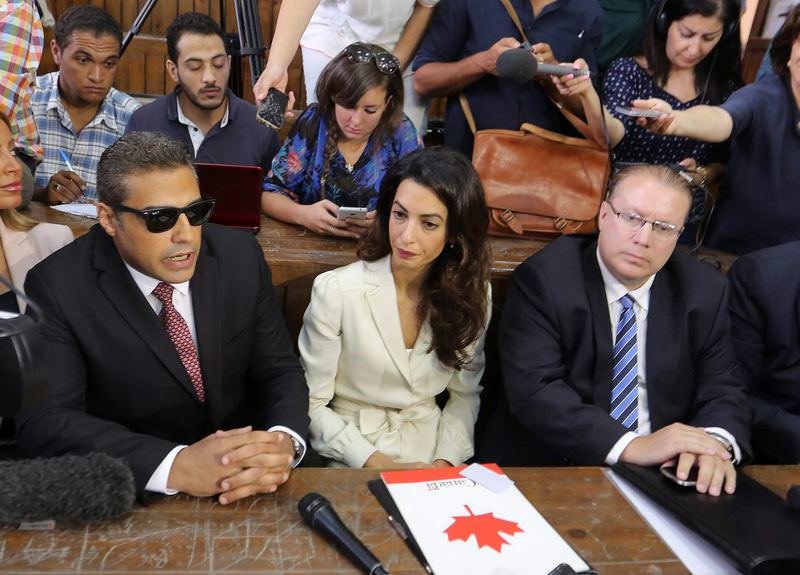
Mohamed Fahmy stands with his legal counsel, human rights lawyer Amal Clooney, and former Canadian Ambassador to Egypt Troy Lulashnyk inside an Egyptian courtroom on the day of his sentencing.
In those moments, Fahmy came to understand not only the human cost of imprisonment, but also the extraordinary power of sustained public pressure and collective action.
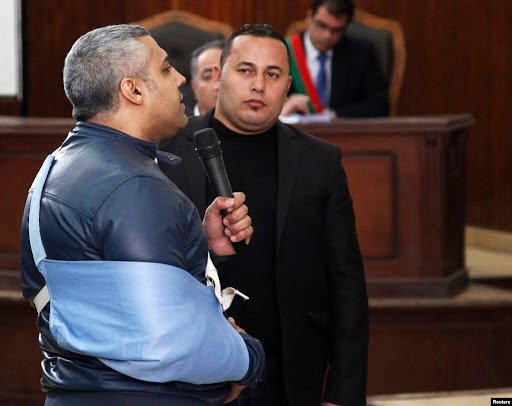
In a rare and extraordinary moment, Fahmy was released from the court’s soundproof cage and granted permission to address the court. Speaking into a microphone handed to him, he openly defended his innocence on May 3, 2014—World Press Freedom Day. He warned the judge, “Today is World Press Freedom Day, and the world will be watching closely.” The statement reverberated far beyond the courtroom, making headlines around the world.
While imprisoned, Fahmy received printed news articles detailing the growing advocacy campaign in Canada—petitions, public demonstrations, and parliamentary calls for his release.
Reading the Canadian Charter of Rights and Freedoms and the Consular Affairs Charter from his cell, he was stunned to learn that Canada has no law requiring government intervention when a Canadian is detained abroad, despite more than 28 countries having such protections in place.
In response, Fahmy and his supporters launched the #HarperCallEgypt campaign, pressing the Prime Minister at the time to take direct action.
Sustained international advocacy and public pressure ultimately helped secure his freedom, as mounting scrutiny challenged the system and led Egypt’s president to grant him a rare presidential pardon in September 2015—days before an Egyptian delegation travelled to the attend the United Nations General Assembly in New York.
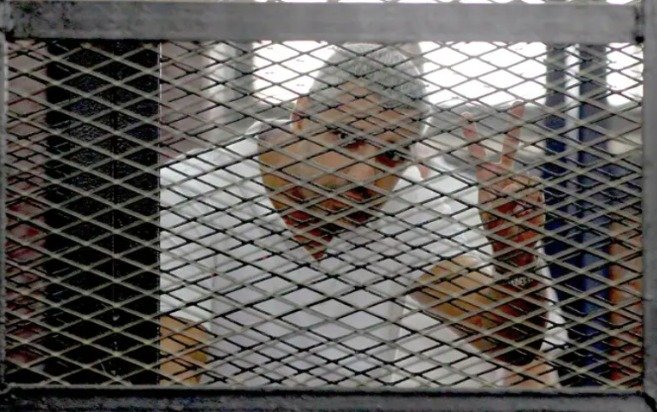
Journalist Mohamed Fahmy inside the soundproof cage in the court during his trial in Cairo, Egypt on June 23, 2014
It was under these harsh conditions that a larger purpose took shape. Witnessing how advocacy and civic engagement could penetrate even the most controlled environments, Fahmy resolved to use the visibility of his own case and the advocacy experience he had garnered to speak for others facing detention and grave human rights violations. It was during his incarceration, confronted daily with life-threatening situations and the profound injustice of his imprisonment, that the idea of the Fahmy Foundation took root. In 2015, while still on trial in Egypt, he brought this vision to life with the support of Canadian lawyers, press freedom advocates, and a dedicated network of supporters—establishing an organization devoted to defending journalists, advancing press freedom, and promoting human rights and freedoms around the world.
At its inception, the Fahmy Foundation launched the Journalists in Distress Fund, providing short-term emergency grants to journalists facing legal proceedings and imprisonment for their work across Africa and the Middle East. The team partnered with leading press freedom organizations and leveraged the global attention surrounding Fahmy’s case to defend persecuted journalists—launching digital advocacy campaigns, organizing public vigils to mobilize support, and coordinating closely with the families of detained acclaimed journalists at the time such as Jason Rezaian, Mahmoud Shawkan, and Woubshet Taye.
With its relaunch in 2026, the Foundation is expanding its commitment to deliver both financial and non-financial assistance to journalists in distress worldwide.
After his release, the Fahmy Foundation—partnering with Amnesty International Canada—introduced the Protection Charter and presented it to the Canadian government in 2016, continuing its push to enshrine consular protection for Canadians abroad in binding law rather than ministerial discretion.
The charter was endorsed by numerous Canadian civil society and press freedom organizations, human rights lawyers, former Canadian diplomats, and previously detained Canadians who support stronger protections for citizens held abroad.
As part of its 2026 relaunch, the Foundation is working with legal counsel and engaging lawmakers to advance legislation that would establish a clear statutory obligation for the Government of Canada to intervene when a Canadian is detained abroad.
Alongside this advocacy, Fahmy’s experience inside prison exposed him directly to the inner workings of Islamist extremist movements. During his detention, he lived among senior figures of the banned Muslim Brotherhood organization and al-Qaeda–affiliated members, sharing meals, spending countless hours in conversation, and listening to their personal histories. In these confined spaces, Fahmy observed how ideology is constructed, justified, and transmitted—how religious narratives are distorted to legitimize violence, and how grievances are cultivated and weaponized. He witnessed firsthand how vulnerable young detainees were targeted, groomed, and radicalized within the prison environment itself. This rare and unsettling proximity provided an unfiltered understanding of extremist recruitment, mindset, and methods.
It is this direct exposure—combined with years of journalism, humanitarian field work with the International Committee of the Red Cross, and extensive research after his release from prison— that is the basis of the Fahmy Foundation's approach to creating the Canada Act Now program. Following his release, Fahmy undertook in-depth research into counter-radicalization programs, documenting and analyzing initiatives around the world. He engaged in filming and investigative work to capture firsthand accounts of de-radicalization, extremist recruitment methodology, and the challenges of disengagement, creating a robust body of evidence to inform effective, evidence-based prevention strategies. This comprehensive experience underpins Canada Act Now’s focus on prevention, disengagement, and the promotion of programs grounded in real-world insights.
While still imprisoned and awaiting the final verdict, Fahmy became the first individual in Canada to be appointed as an adjunct professor while behind bars. Upon returning to Canada, he lectured at the University of British Columbia on journalism, geopolitics, political Islam, and the mechanisms of radicalization and recruitment targeting Muslim youth.
Mohamed Fahmy is an award-winning journalist, human rights defender, whose career began covering some of the world’s most complex conflict zones. He entered Iraq on the first day of the U.S.-led invasion in March 2003, for the Los Angeles Times, and went on in 2004 to produce feature stories across the Arabian Gulf for Dubai Television, including in Oman, Kuwait, Iraq, Bahrain, and the United Arab Emirates.
These early experiences laid the groundwork for his lifelong commitment to documenting human rights, conflict, and the challenges of global security.
In 2007, Fahmy joined the International Committee of the Red Cross (ICRC) as a member of its Lebanon Protection Team. His work focused on safeguarding the rights of individuals affected by armed conflict, advocating for protections under the Geneva Conventions, and delivering life-saving humanitarian assistance. As part of this role, Fahmy conducted regular prison visits across Lebanon, including Roumieh and Yarze prisons in Beirut. He carried out unescorted interviews inside prison cells with a wide range of detainees, including:
- Senior political detainees, including former ministers, security and intelligence officials, held in connection with nationally significant political cases
- Members of Hezbollah and Hamas, detained on security and terrorism-related allegations
- Hundreds of members of Fateh el-Islam, a Sunni Islamist militant organization inspired by al-Qaeda and responsible for prolonged armed clashes with the Lebanese Armed Forces at the Nahr al-Bared refugee camp in 2007— some militants later went on to merge with or support other extremist organizations, including ISIL and the Al-Nusra Front, operating in Lebanon and Syria.
During his daily work with the ICRC, Fahmy also facilitated confidential communication between detainees and their families, assisted refugees, traced missing persons, distributed humanitarian aid during field operations, and documented cases of ill-treatment and torture in detention facilities. In line with ICRC protocols, these findings were submitted confidentially to Lebanese authorities and were never shared with the media.
As part of the ICRC’s neutral and impartial mandate, Fahmy participated in and supported ICRC-led training sessions on International Humanitarian Law (IHL) delivered to various levels of the Lebanese Armed Forces, contributing to the integration of humanitarian principles into military operations and doctrine.
He also conducted regular humanitarian work supporting refugees and tracing the missing inside numerous camps such as Ain al-Hilweh and Al-Beddawi, home to tens of thousands of displaced Palestinians and Syrians.
This direct, sustained access—conducted without government escorts and under strict humanitarian confidentiality—provided Fahmy with rare, firsthand insight into the motivations, internal dynamics, and ideological narratives of a wide range of political actors and Islamist movements operating across the region. The International Committee of the Red Cross (ICRC) has not been granted access to Egyptian prisons and detentions sites as of 2026.
Following his humanitarian work, Fahmy joined Middle East Broadcasting Networks (MBN) in 2008, managing flagship programming and travelled with the network executives to Israel, Egypt, Lebanon, and the United Arab Emirates to help recruit anchors, reporters, camera crews, to establish regional bureaus across the Middle East. In 2011, he joined CNN in Cairo during the early days of Egypt’s revolution and went on to cover the Arab Spring in Syria and Libya. During this period, Fahmy repeatedly reported from Egypt’s Sinai Peninsula, where he interviewed members of Ansar Bayt al-Maqdis, a Salafi-jihadist group that later pledged allegiance to ISIL. His reporting involved:
- Direct engagement with Bedouin tribal leaders
- Access to smuggling tunnels along the Gaza border
- Interviews with militant actors and documentation of Islamic extremist ecosystems
In 2012, Fahmy was part of CNN’s investigative team awarded the Tom Renner Award for Death in the Sinai, a documentary exposing human trafficking and organ sales networks. That same year, Fahmy conducted rare interviews with senior Islamist figures, including Mohamed al-Zawahiri, a leader of Egyptian Islamic Jihad and the younger brother of the late leader of Al Qaeda, and Aboud el-Zomor, a senior figure in al-Gama’a al-Islamiyya.
These interviews provided critical insight into how extremist actors justify violence as a means of political transformation.
In 2013, Fahmy joined Al Jazeera English as Egypt Bureau Chief. Months later, he and two colleagues were arrested during a televised state security raid and transferred to Egypt’s maximum-security Scorpion Prison.
Fahmy spent 438 days in detention, including extended periods of solitary confinement, and was later sentenced to seven years on terrorism-related charges following a trial that was widely condemned as politically motivated. The proceedings were described as a travesty of justice by his lawyer, Amal Clooney, senior Canadian and U.S. officials, and reputable international bodies, including the United Nations and leading press freedom organizations such as Canadian Journalists for Free Expression.
During his imprisonment, Fahmy witnessed the radicalization of younger detainees and engaged in sustained dialogue with senior Islamist figures, including leaders of the Muslim Brotherhood, providing rare insight into the dynamics of ideological indoctrination and prison-based radicalization.
Released on bail but banned from leaving Egypt during his 2015 retrial, Fahmy and his legal team founded the Fahmy Foundation in Vancouver, transforming his personal ordeal into a global advocacy platform supporting jailed journalists and prisoners of conscience.
He was later re-sentenced to three years before receiving a presidential pardon in September 2015, shortly before Egypt’s delegation traveled to the United Nations General Assembly.
While imprisoned, Fahmy became the first individual in Canada to be appointed as an adjunct professor while behind bars. Upon returning to Canada, he lectured at the University of British Columbia on journalism, Middle East geopolitics, political Islam, and the mechanisms of radicalization and recruitment targeting Muslim youth.
In 2016, the Foundation—alongside Amnesty International Canada—launched the Protection Charter, a twelve-point proposal calling for mandatory government protection for Canadians detained abroad. Fahmy testified before the House of Commons Standing Committee on Foreign Affairs and International Development, contributing to national policy discussions on consular protection.
After a temporary pause during the COVID-19 pandemic, the Fahmy Foundation relaunched in January 2026 from Montreal, responding to what global watchdogs describe as the most severe decline in press freedom in decades.
In recent years, Fahmy has deepened his work on prevention and counter-radicalization through extensive field research and engagement with certified disengagement programs operating internationally. As part of this effort, he observed, filmed, and documented multiple intervention sessions led by a community-based organization in London, England, which specializes in mentoring individuals vulnerable to or already drawn into extremist ideologies.
These findings directly informed the development of Canada Act Now, the Fahmy Foundation’s prevention-focused initiative designed to address radicalization before it escalates into violence. The research reinforced Fahmy’s long-held assessment that effective prevention and disengagement are not achieved through surveillance or punitive measures alone, but require time, trust, lived credibility, and deep ideological literacy—particularly an understanding of how religious concepts are systematically misinterpreted and weaponized by experienced extremist recruiters to exploit grievances, identity crises, and social marginalization.
Today, the Foundation continues its work through:
- Press freedom advocacy and journalist protection
- Public policy engagement on Islamic extremism and security
- Prevention and counter-radicalization initiatives, including Canada Act Now, developed with experienced practitioners, including, the head of research Theo Padnos, a former hostage kidnaped by Al Qaeda in Syria for two years.
- Human-rights-centered approaches that challenge extremist ideology while upholding democratic values
The Fahmy Foundation’s work is grounded in lived experience, rigorous research, and a commitment to protecting freedom, dignity, and accountability in Canada and globally.
- Tom Renner Investigative Reporting Award ( USA-2011)
Awarded for Death in the Desert, produced for CNN’s Freedom Project, in recognition of investigative reporting that exposed large-scale human trafficking networks operating in Egypt’s Sinai Peninsula.
- Peabody Award (USA-2011)
Received as part of the CNN team for outstanding coverage of the Arab Spring uprisings across the Middle East and North Africa.
- Canadian Commission for UNESCO – World Press Freedom Award (Canada-2014)
Presented alongside a formal certificate from UNESCO in recognition of courage, resilience, and commitment to press freedom.
- Royal Television Society Journalism Judges’ Award (London-2015)
Awarded to Fahmy and his colleagues for their principled stand in defense of press freedom.
- Voltaire Human Rights Award (Australia-2015)
Presented by Liberty Victoria,Australia’s annual free speech and civil liberties organization to Fahmy and his colleagues recognizing outstanding contributions to freedom of expression and civil liberties.
- International Association of Press Clubs – Freedom of Speech Award (Poland-2015)
Recognizing sustained advocacy for freedom of expression and journalistic independence.
- Writers’ Union of Canada – Freedom to Read Award (Canada-2016)
Honoring leadership and advocacy in defense of free expression and the public’s right to information.
- British Columbia Civil Liberties Association – Liberty Award (Canada-2016)
Granted in recognition of Fahmy’s contributions to the advancement of human rights and civil liberties.
Foundation: Born from Injustice
For 438 days, award-winning journalist Mohamed Fahmy endured unjust detention in Egypt’s maximum-security prison system after being sentenced to seven years in prison in 2014, including several months in prolonged solitary confinement. He was confined in windowless, often insect-infested cells, with no exposure to sunlight and little opportunity for outdoor exercise—conditions designed to isolate, disorient, and break the human spirit.
Yet even in this enforced silence, the outside world found ways to reach him. Family-monitored visits, when permitted, carried their own quiet acts of resistance.
Mohamed Fahmy, human rights lawyer Amal Clooney and former Canadian ambassador to Egypt Mr. Troy Lulashnyk in the Court in Egypt on the day Fahmy was sentenced.
Messages and news clippings were concealed beneath rice in food trays—small, risky gestures that allowed the voices of supporters to pass through layers of censorship and surveillance. In those moments, Fahmy came to understand not only the human cost of imprisonment, but also the extraordinary power of sustained public pressure and collective action.
Fahmy, an Egyptian-Canadian citizen, received printed global news articles documenting the growing advocacy campaign in Canada—reports of petitions, public demonstrations, and parliamentary attention calling for his release. These fragments of news became lifelines, tangible proof that his case had not been forgotten. Sustained international advocacy and public pressure ultimately helped secure his freedom, as mounting scrutiny challenged a fragile authoritarian system and led Egypt’s president to grant him a rare presidential pardon in September 2015—days before an Egyptian delegation travelled to the attend the United Nations General Assembly in New York.
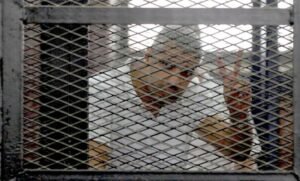
Journalist Mohamed Fahmy sits inside the court’s cage during trial in Cairo, Egypt on June 23, 2014
It was under these harsh conditions that a larger purpose took shape. Witnessing how advocacy and civic engagement could penetrate even the most controlled environments, Fahmy resolved to use the visibility of his own case and the advocacy experience he had garnered to speak for others facing detention and grave human rights violations. It was during his incarceration, confronted daily with life-threatening situations and the profound injustice of his imprisonment, that the idea of the Fahmy Foundation took root. In 2015, while still on trial in Egypt, he brought this vision to life with the support of Canadian lawyers, press freedom advocates, and a dedicated network of supporters—establishing an organization devoted to defending journalists, advancing press freedom, and promoting human rights and freedoms around the world. Alongside this advocacy, Fahmy’s experience inside prison exposed him directly to the inner workings of Islamist extremist movements. During his detention, he lived among senior figures of the banned Muslim Brotherhood organization and al-Qaeda–affiliated members, sharing meals, spending countless hours in conversation, and listening to their personal histories. In these confined spaces, Fahmy observed how ideology is constructed, justified, and transmitted—how religious narratives are distorted to legitimize violence, and how grievances are cultivated and weaponized. He witnessed firsthand how vulnerable young detainees were targeted, groomed, and radicalized within the prison environment itself. This rare and unsettling proximity provided an unfiltered understanding of extremist recruitment, mindset, and methods. It is this direct exposure—combined with years of journalism, humanitarian work with the International Committee of the Red Cross, and extensive research after his release from prison—that forms the foundation of Canada Act Now’s approach. Following his imprisonment, Fahmy undertook in-depth research into counter-radicalization programs, documenting and analyzing initiatives around the world. He engaged in filming and investigative work to capture firsthand accounts of radicalization, extremist recruitment, and the challenges of disengagement, creating a robust body of evidence to inform effective, evidence-based prevention strategies. This comprehensive experience underpins Canada Act Now’s focus on prevention, disengagement, and the promotion of programs grounded in real-world insights.